Product framing & judgment
I framed the opportunity, defined the first user segment, prioritized the minimum viable product, and designed the trust and measurement model.
What if ChatGPT connected the work we do across sessions to the outcome we are trying to achieve?
A long-running goal can involve research, drafts, decisions and follow-up across many conversations. My hypothesis is that an explicit goal, supported by evidence, could help users resume work and see what still needs attention.
I propose Goal Graph: a user-defined outcome with success criteria, milestones and links to relevant work. This case study presents my product proposal and an illustrative interaction, rather than a shipped ChatGPT feature or measured customer results.
I framed the opportunity, defined the first user segment, prioritized the minimum viable product, and designed the trust and measurement model.
Frequent users working across sessions on a job search, portfolio, research deliverable or launch. A clear endpoint makes progress easier to evaluate.
Help users return with clarity, locate the right evidence and focus on an unresolved milestone. Test whether that improves continuity and longer-term retention.
Consider someone pursuing a Senior Product Manager role. Resume feedback, company research, portfolio editing and interview preparation may all serve the same goal. The user still has to reconstruct what is finished, what counts as progress, and what to do next.
“I know we worked on this. What did we decide, which version is final, and what is still missing?”
One persistent outcome connects the relevant work. Milestones summarize the state; evidence explains why that state changed.
Success criterion: I accept an offer for a Product Manager, Senior Product Manager or AI Product Manager role.
OpenAI documents Projects as a way to keep related chats, files and instructions together. My proposal adds an outcome that could span more than one workspace. Whether users need a separate Goal object, or a lighter extension within Projects, is a discovery question.
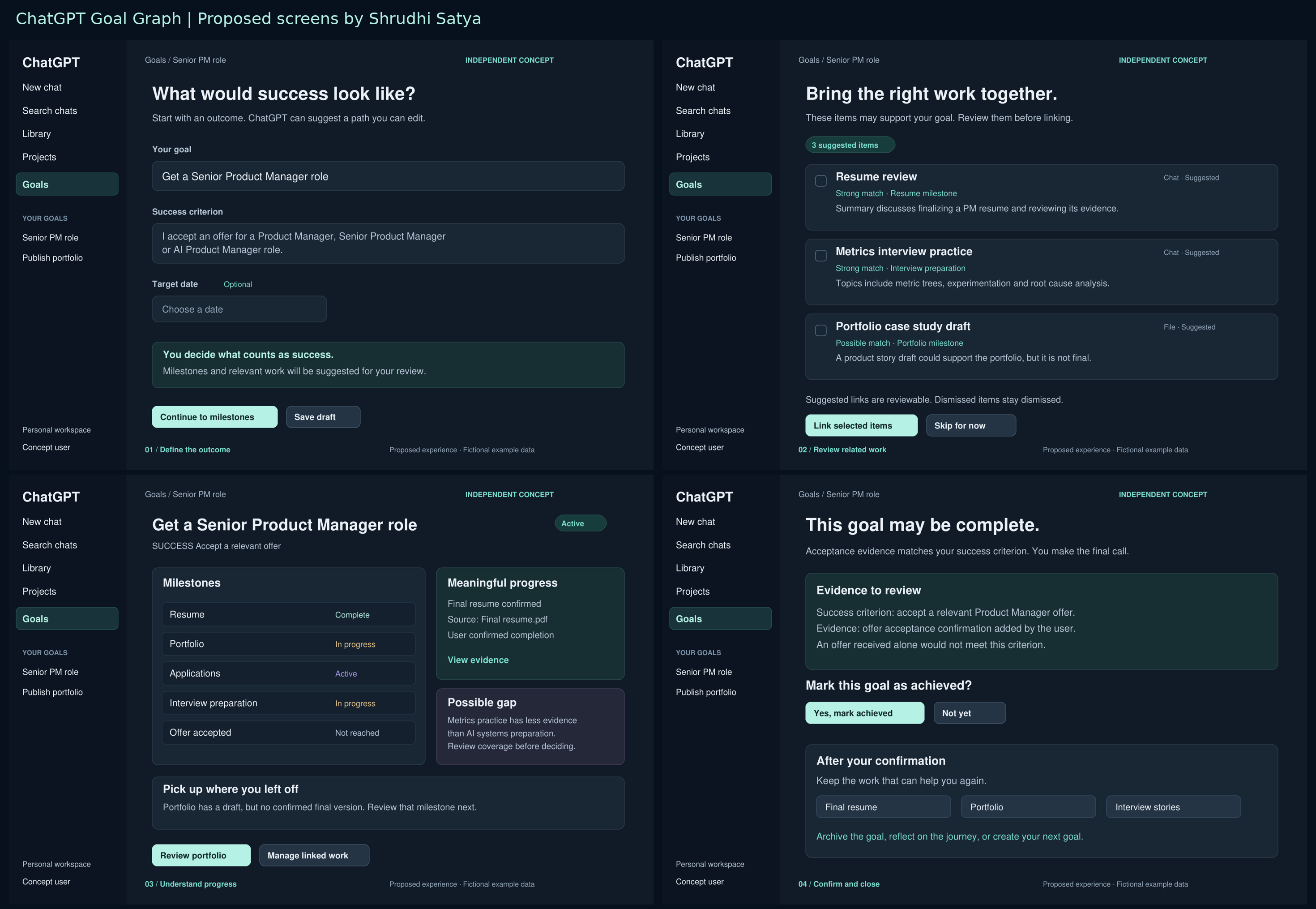
Product baseline: Projects in ChatGPTFour concept screens show how Goal Graph could fit into a ChatGPT-style workspace. The examples use fictional data. Select a stage to explore it, or open the screen at full size.
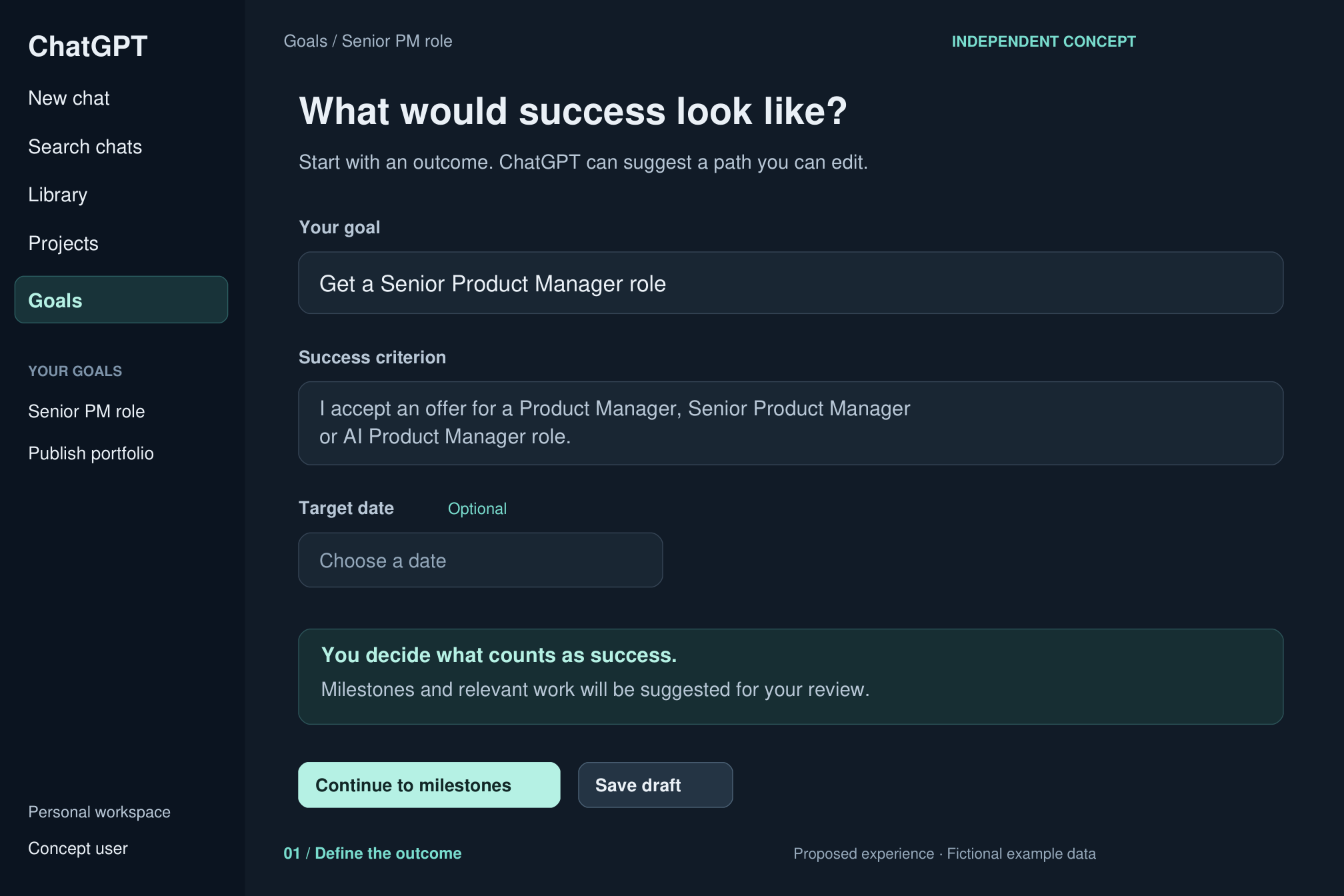
The user declares an outcome and an explicit success criterion. A target date stays optional.
View full-size screen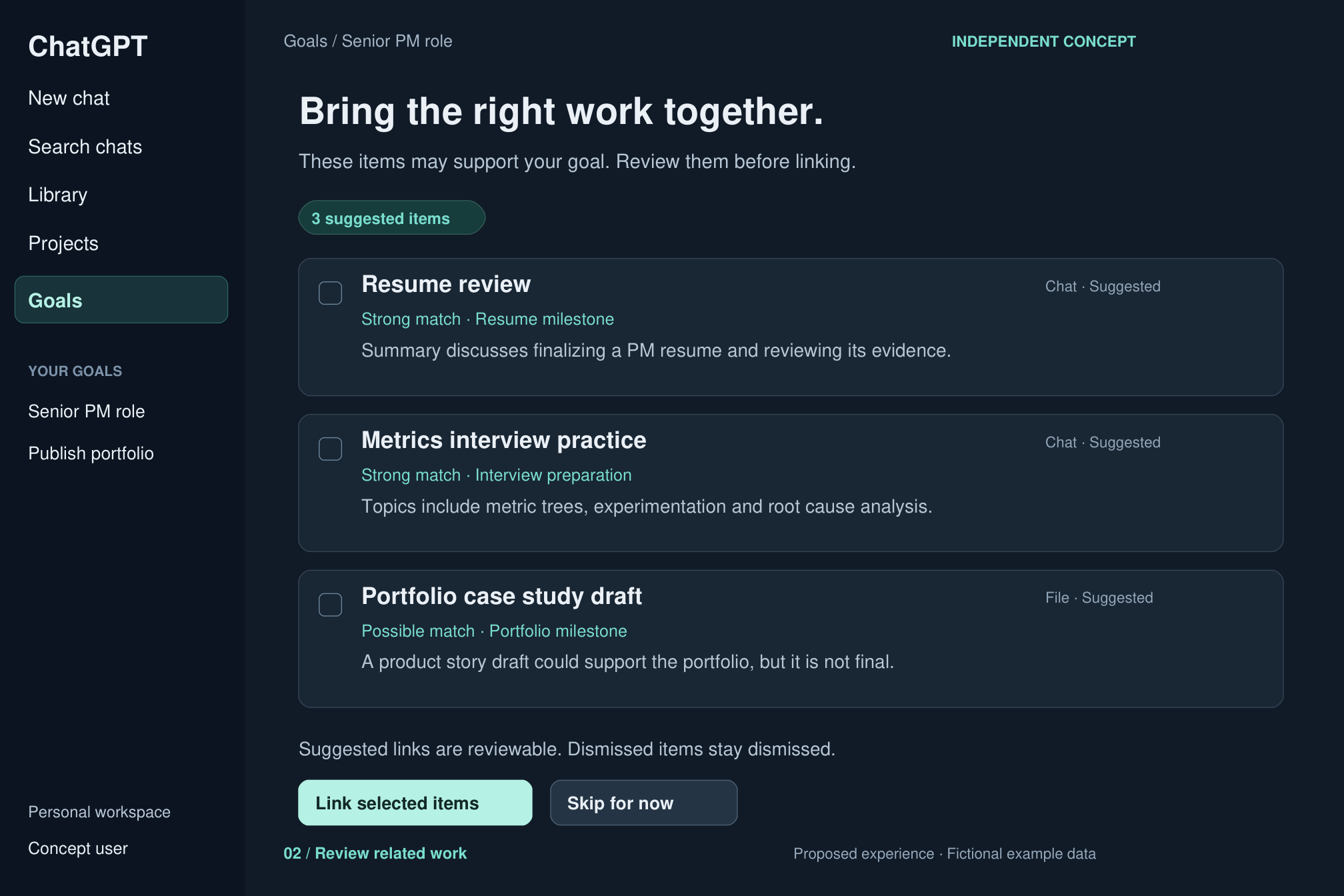
Relevant chats and files appear as suggestions with a reason. The user chooses what belongs.
View full-size screen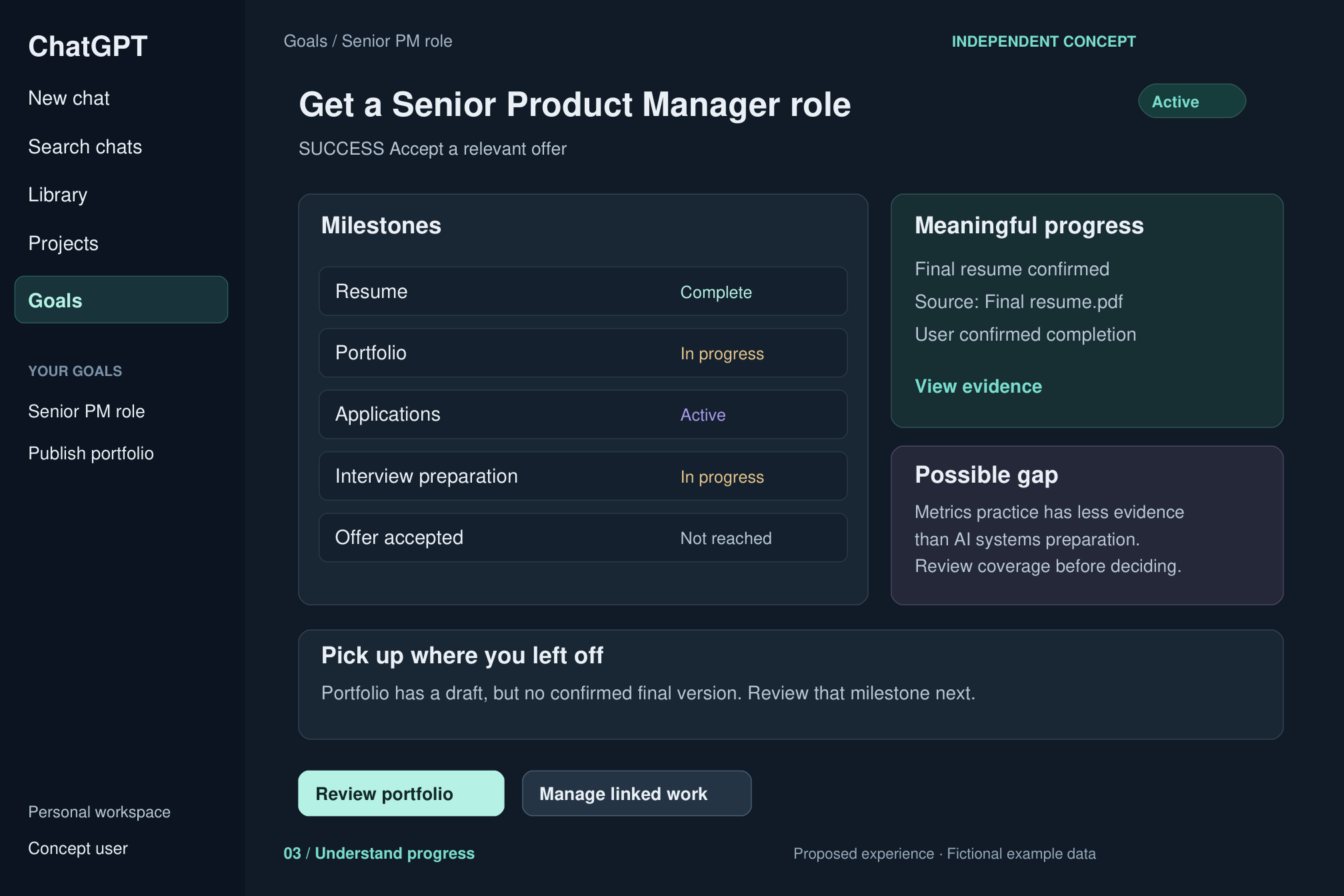
Milestones show their state alongside supporting evidence. The possible-gap panel illustrates a later phase of the concept.
View full-size screen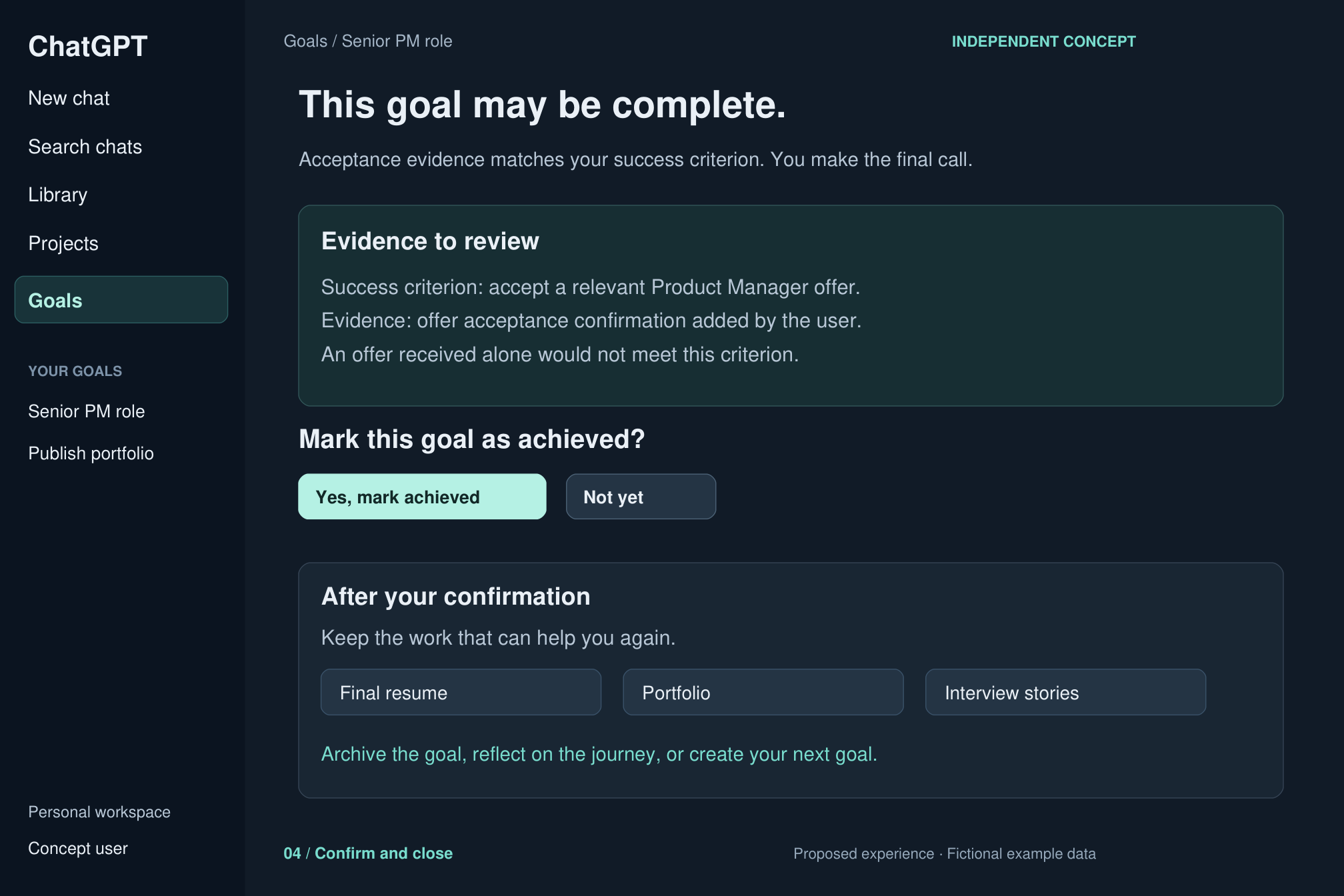
Acceptance evidence can trigger a completion suggestion. The user confirms achievement before closure and asset reuse.
View full-size screenThis interactive example uses fictional evidence. Select a milestone, review a suggested link, then compare receiving an offer with accepting one.
Success: accept a relevant offer.
A final resume file and the user’s confirmation support this milestone. Opening more resume chats would not advance it.
The topic and summary suggest this conversation supports interview preparation. The title alone is not enough.
Suggested · Awaiting your review
No acceptance evidence yet. The goal remains active.
Acceptance evidence matches the success criterion. Mark this goal achieved?
Decision: Let users create the goal and define success. Offer milestones they can edit.
Trade-off: A little setup friction buys clarity and control. I would avoid inferring sensitive life goals.
Decision: Tie state changes to a final artifact, completed action or user confirmation.
Trade-off: Conservative updates may miss progress, but chat volume and draft generation can create false confidence.
Decision: Suggest relevant chats and files with an explanation. Let users accept, unlink or reject them.
Trade-off: A smaller useful set is preferable to a crowded goal with unrelated context.
Decision: Show milestones, recent evidence and an unresolved gap in the primary view.
Trade-off: The underlying relationships can be rich without making users navigate a dense node graph.
Decision: AI may flag possible completion; the user confirms achievement.
Trade-off: Receiving an offer is evidence of progress, but it does not satisfy an acceptance criterion.
Decision: Rank candidates using summaries, topics and semantic relevance; fetch detailed content when needed.
Trade-off: This proposed architecture controls latency and cost, but summary quality and stale evidence need evaluation.
Evidence should retain its source and permission boundaries. A goal summary must stop using a source when access is removed. Conflicting or incomplete evidence should trigger review instead of a confident state change.
Explicit goal and success criterion, editable milestones, manual links, suggested chat and file links, evidence-backed updates, a progress summary and confirmed closure.
Improve evidence detection and closure summaries. Then test gap detection, optional summaries and permissioned external evidence.
Team goals, ongoing goals, autonomous execution, dependency graphs, streaks and a full task board would wait until the core value is proven.
Weekly evidence-backed milestone advances divided by active goals in that week. Define active as a goal viewed or updated during the window; count unique state changes and exclude reversals, duplicates and chat activity.
Audit whether recorded advances reflect real progress. Use this alongside continuity and quality measures, since recording more events alone does not prove value.
| Question | Measure | Why it matters |
|---|---|---|
| Does setup lead to value? | Activation: goals with success criteria, a milestone and linked evidence / goals created. | Creation alone is too easy to mistake for adoption. |
| Can users resume confidently? | Time to resume a defined task; user-rated clarity on what remains. | Tests the central continuity hypothesis. |
| Are connections relevant? | Link precision from user reviews and sampled evaluation; rejection rate separately. | Acceptance is a signal, not proof of correctness. |
| Does value persist? | 30- and 60-day retention in randomized eligible cohorts. | Separates feature impact from already engaged users selecting it. |
| Is trust protected? | False completion suggestions, incorrect state updates, privacy incidents, retrieval latency and compute cost. | Growth should not come at the cost of control or reliability. |
I would establish baseline performance through research and evaluation, then set targets for the beta.
Ask frequent multi-session users to show how they resume a real goal. Look for repeated reconstruction, lost decisions and uncertainty about remaining work.
Test a goal with milestones and an evidence summary against a comparable Projects experience. Measure resumption speed, clarity and evidence-backed advances.
Compare manual linking with AI suggestions. Include misleading titles, unrelated topics and offer-without-acceptance cases to test precision and premature completion.
My scale decision: Expand only if users resume more clearly, relevant links remain precise, and progress detection is trustworthy. If the same value is achieved with a simpler Projects extension, choose that route. Retention is a hypothesis to test after the core user value is established.
The product opportunity is to reduce the effort of keeping a long journey coherent, while leaving the definition of success with the person pursuing it.
Explore What If?